The Customer Is Already Online
Imagine a potential customer visits your business website at 10:45 PM.
They want to know how much your service costs. They have another question about delivery. They want to know whether you are open tomorrow. They may even be ready to buy.
But nobody is available to answer.
The customer sends a WhatsApp message and waits. They visit your website and leave. They send an email and move on to another business that responds faster.
This is a common problem for small businesses. The problem is not necessarily that the business provides poor customer service. Sometimes there simply are not enough people available to respond to every customer at every hour of the day.
This is where AI chatbots for Kenyan businesses are becoming increasingly useful.
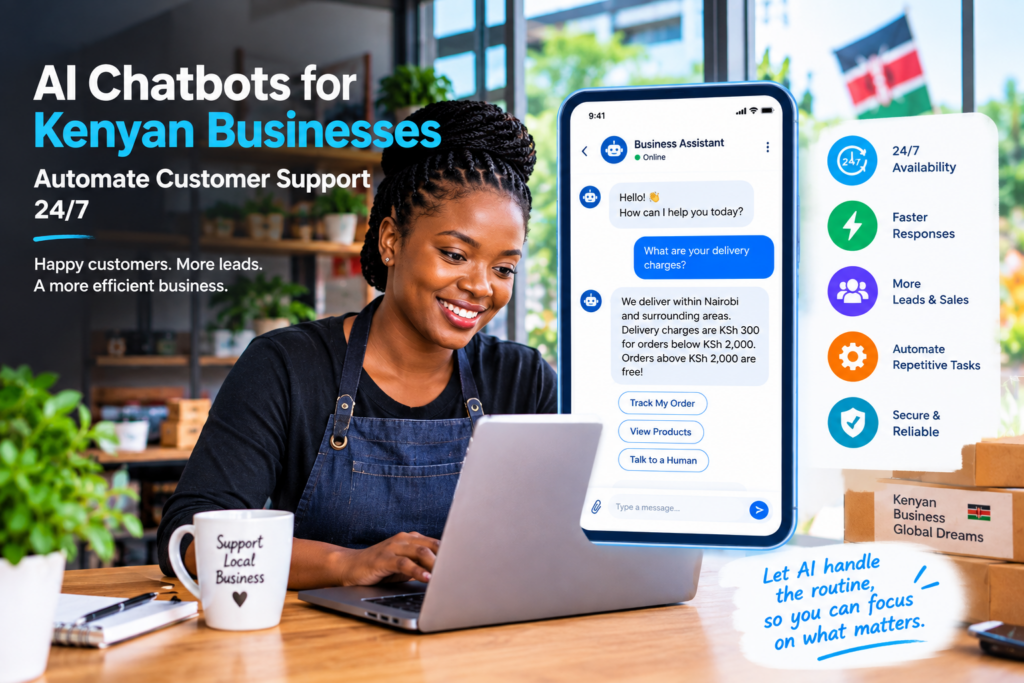
An AI chatbot can answer common questions, provide information, collect customer details, qualify leads, assist with bookings, guide customers through products and services, and hand complicated conversations over to a human member of staff.
The important point is that an AI chatbot should not be viewed as a replacement for your employees. Instead, it can act as a digital first line of support that handles repetitive conversations while your team focuses on customers and tasks that require human judgement.
For Kenyan businesses that rely heavily on websites, social media and messaging platforms to communicate with customers, this can create a significant opportunity to improve responsiveness without having to employ someone to sit behind a computer or phone 24 hours a day.
2. What Is an AI Chatbot?
An AI chatbot is software that uses artificial intelligence to communicate with people through a conversational interface.
Traditional chatbots usually depend on predefined rules.
For example:
Customer: What time do you close?
Traditional chatbot: Choose an option:
- Opening hours
- Products
- Contact us
An AI chatbot can understand a more natural question.
Customer: Are you guys still open this evening?
The system can understand that the customer is asking about business hours and provide the relevant response.
More advanced AI chatbots can use a business’s own information, including its website content, product catalogue, FAQs, policies, documents and other approved information.
This means the chatbot can become a digital assistant specifically designed around the business.
The technology can also connect to other systems. For example, a chatbot could potentially check appointment availability, retrieve order information, collect customer details, create a support ticket or direct a customer to a payment process.
The important distinction is that a useful business chatbot is not simply an AI model placed on a website.
It is an AI system connected to a business workflow.
3. Why AI Chatbots Matter for Kenyan Businesses
Kenya is already a highly connected mobile market, making digital customer communication increasingly important for businesses.
The Communications Authority of Kenya reported 84.1 million active mobile subscriptions in the third quarter of FY2025/26, while active mobile-money subscriptions reached 53.4 million. Mobile broadband consumption also continued to grow.
For businesses, this means customers are increasingly comfortable interacting with companies through digital channels.
A customer may discover your business through Google, Instagram, Facebook, TikTok or your website and then move to WhatsApp to ask a question.
The challenge is that customer communication can become difficult to manage as the business grows.
One employee might be handling WhatsApp.
Another might be responding to Facebook messages.
Someone else might be checking website enquiries.
Meanwhile, customers expect fast responses.
An AI chatbot can help bring these conversations into a more organised workflow.
Instead of making customers wait for a person to answer every simple question, the chatbot can handle routine enquiries immediately and involve a human when necessary.
4. AI Chatbots Can Provide 24/7 Customer Support
One of the biggest advantages of an AI chatbot is availability.
Your employees need to go home.
They need weekends.
They need holidays.
They may be in meetings or serving customers.
An AI system can continue handling routine conversations outside normal working hours.
Suppose you operate a web development company.
A potential customer visits your website at midnight and asks:
“How much does it cost to build an e-commerce website?”
Your chatbot could explain the factors that affect pricing, describe your services, ask what type of website the customer needs and collect their contact details.
The following morning, your team can review the conversation and continue from where the chatbot stopped.
The same concept can work for restaurants, hotels, real estate companies, schools, clinics, online shops, consultancies, travel companies, law firms and many other businesses.
The goal is not necessarily to automate every conversation.
The goal is to make sure a customer is not ignored simply because a human employee is temporarily unavailable.
5. AI Chatbots for Website Customer Support
Your website can become much more interactive with an AI chatbot.
Instead of having a website that simply displays information, you can allow visitors to ask questions directly.
For example:
Customer: Do you design websites for schools?
AI: Yes. We develop websites for schools and education organisations. We can assist with school websites, admissions information, online forms, news updates and other digital features. Would you like to discuss your project?
This is more engaging than forcing visitors to search through multiple pages.
A website chatbot can also direct visitors to relevant pages.
For example:
- Services
- Pricing
- Portfolio
- Frequently Asked Questions
- Contact
- Booking
- Support
- Products
- Documentation
The chatbot essentially becomes an intelligent navigation layer for the website.
For businesses receiving many website enquiries, this can make the website more useful while reducing repetitive questions for employees.
6. WhatsApp AI Chatbots Could Be Particularly Useful in Kenya
For many Kenyan businesses, customer conversations already happen through WhatsApp.
A business might receive messages such as:
“How much is this?”
“Where are you located?”
“Do you deliver to Rongai?”
“Can I book for Saturday?”
“Do you accept M-Pesa?”
“Send me your price list.”
“Is this product available?”
These questions are repetitive.
The customer may not care whether a human or AI provides the answer as long as the information is accurate and the conversation is useful.
A properly implemented WhatsApp AI chatbot can therefore handle common enquiries while allowing staff to take over when the conversation becomes more complex.
Businesses should, however, use official WhatsApp Business infrastructure and follow applicable platform policies rather than relying on questionable automation methods.
WhatsApp’s business policies also emphasise clear escalation paths, including human-agent support, phone, email or web support, particularly when automation cannot adequately handle a customer’s issue.
7. Customer Service Is Not the Only Use Case
It is easy to think of an AI chatbot as simply a tool that answers questions.
That is only one application.
A properly designed chatbot can become part of a larger business process.
For example, a real estate company could use a chatbot to:
- Ask a customer what type of property they want.
- Ask their preferred location.
- Ask their budget.
- Ask whether they want to buy or rent.
- Recommend relevant properties.
- Collect their contact details.
- Schedule a viewing.
- Notify a sales representative.
A salon could use one to:
- Display available services.
- Provide prices.
- Answer questions.
- Recommend services.
- Check appointment availability.
- Collect customer details.
- Confirm bookings.
An online shop could use one to:
- Help customers find products.
- Answer product questions.
- Explain delivery options.
- Provide order information.
- Assist with returns.
- Escalate complaints.
This is where chatbot technology becomes more interesting.
It stops being just a chat box and starts becoming a business automation system.
8. AI Chatbots Can Help Generate Leads
A website visitor is not necessarily a customer.
They might be researching.
They might be comparing prices.
They might not be ready to buy immediately.
A traditional website may simply allow that visitor to leave.
An AI chatbot can start a conversation.
For example:
AI: Welcome! Are you looking for a website for your business?
Visitor: Yes.
AI: Great. What type of business do you operate?
Visitor: I run a school.
AI: We can help with school websites and related digital solutions. Would you like to tell us what features you need?
The chatbot can then collect information such as:
- Name
- Phone number
- Email address
- Business type
- Service required
- Budget range
- Location
- Preferred contact method
Instead of receiving an anonymous website visitor, the business receives a qualified enquiry.
This can be particularly useful for service businesses where every qualified lead has potential commercial value.
9. AI Chatbots Can Qualify Customers Before Human Follow-Up
Not every enquiry deserves the same response.
Imagine a company receives 100 enquiries in a week.
Twenty might be serious prospects.
Thirty might be general questions.
Twenty might be existing customer support requests.
The rest might not be relevant.
A chatbot can ask initial questions and categorise conversations.
For example:
New Sales Lead
The customer wants to purchase a service.
Existing Customer
The customer needs support.
General Enquiry
The customer wants basic information.
High-Priority Issue
The customer needs immediate human assistance.
This allows employees to focus their attention where it matters most.
The chatbot becomes a filter that helps organise customer communication.
10. AI Chatbots Can Answer Frequently Asked Questions
Every business has repetitive questions.
A hotel may repeatedly receive:
“What time is check-in?”
“Do you have Wi-Fi?”
“Do you offer airport transfers?”
A school might receive:
“When does admission open?”
“What documents do I need?”
“Where is the school located?”
An online shop might receive:
“How much is delivery?”
“How long does delivery take?”
“Do you accept M-Pesa?”
A software company might receive:
“Do you offer support?”
“How much does the system cost?”
“Can I request a demo?”
Instead of making employees answer the same questions repeatedly, these answers can be incorporated into an AI knowledge base.
The chatbot can then provide consistent information.
This also creates another benefit.
When business information changes, the knowledge base can be updated.
For example, if delivery charges change, the chatbot’s information should be updated rather than allowing it to continue giving customers an old price.
11. AI Chatbots Can Support Sales
A good chatbot should not simply answer questions.
It can help customers move toward a purchase.
Consider an online furniture business.
A customer asks:
“Do you have office desks?”
The chatbot could respond with available options and ask:
“What size are you looking for?”
The customer answers.
The chatbot can then present relevant products.
It could also answer questions about:
- Price
- Materials
- Availability
- Delivery
- Warranty
- Payment options
The customer can then be directed toward checkout or a human sales representative.
The important principle is that the chatbot should help remove friction from the buying process.
The fewer unnecessary steps between the customer’s question and the solution, the better the digital experience can become.
12. AI Chatbots Can Work With M-Pesa and Other Business Systems
One of the most interesting possibilities for Kenyan businesses is connecting conversational interfaces to existing business systems.
For example, a customer could interact with a chatbot and eventually be guided through a payment process.
A business could potentially connect the chatbot to:
- Payment systems
- M-Pesa integrations
- CRM systems
- Inventory systems
- Booking systems
- Accounting software
- E-commerce platforms
- Customer databases
- Help-desk systems
This is where custom software development becomes important.
A simple chatbot can answer questions.
A custom AI-powered application can interact with your business systems.
For example, instead of telling a customer:
“Your order is being processed.”
A connected system could retrieve the customer’s actual order status and provide relevant information.
This requires proper API integration, authentication, security and business logic.
AI provides the conversational layer, while software development provides the infrastructure underneath it.
13. AI Chatbots Can Help Businesses Handle More Customers
Suppose five customers send messages at the same time.
A human employee can only handle a limited number of conversations.
An AI system can handle multiple conversations simultaneously.
This does not mean businesses should remove human support.
It means humans can spend less time answering repetitive questions.
Consider a customer support employee who normally spends several hours every day answering:
“What are your opening hours?”
“Where are you located?”
“How much does this cost?”
“How do I book?”
If an AI system handles those questions, the employee can spend more time solving complicated customer problems.
The result is not simply automation.
It is better allocation of human attention.
14. AI Chatbots Should Understand Your Business
One of the biggest mistakes businesses can make is deploying a generic AI chatbot without giving it reliable business information.
A general AI model may know a lot about the world.
It does not automatically know:
- Your latest prices
- Your company policies
- Your product inventory
- Your opening hours
- Your delivery areas
- Your refund policy
- Your internal procedures
- Your service packages
This information needs to be supplied through a controlled knowledge base or connected systems.
For example, if you run a restaurant, the chatbot should have access to the current menu.
If you operate a school, it should have access to approved school information.
If you operate an e-commerce business, product availability should come from the actual inventory system where appropriate.
The quality of the chatbot is therefore heavily influenced by the quality of the information behind it.
15. The Importance of Human Handover
AI should know when to stop.
This is one of the most important principles of business chatbot development.
A customer might say:
“I have been charged twice.”
That is probably not something a chatbot should simply guess about.
A better workflow would be:
AI: I can help with that. Let me collect a few details and connect you with our support team.
The customer provides the required information.
The conversation is transferred to a human.
Human handover is especially important when dealing with:
- Complaints
- Refunds
- Payments
- Sensitive information
- Complex technical issues
- Legal matters
- Medical questions
- High-value customers
- Angry or distressed customers
The chatbot should make it easy for the customer to reach a person.
16. Data Privacy Must Be Part of the Design
AI chatbot projects involve data.
Customers may provide names, phone numbers, email addresses, addresses, order details or other personal information.
Businesses therefore need to think about privacy before launching an AI chatbot.
Kenya’s Office of the Data Protection Commissioner states that people have rights relating to their personal data, including being informed about how data is used, accessing their information, objecting to processing and requesting correction or deletion in applicable circumstances.
The ODPC has also specifically highlighted data-protection considerations when organisations use AI, including issues around increased data collection, informed consent, safeguards and data-protection impact assessments where necessary.
Businesses should therefore consider:
- What information is being collected?
- Why is it being collected?
- Where is it stored?
- Who can access it?
- How long is it retained?
- Is it being shared with another service provider?
- Does the business have the appropriate privacy notices?
- Are sensitive details being unnecessarily requested?
Privacy should not be added after the chatbot has already been launched.
It should be considered during the design stage.
17. Security Is Just as Important as Intelligence
An impressive chatbot with poor security can create serious problems.
Businesses should protect the systems connected to their AI assistants.
Security measures may include:
- Strong authentication
- Access controls
- Secure API keys
- Encryption
- Audit logs
- Regular software updates
- Rate limiting
- Monitoring
- Backup systems
- Human approval for sensitive actions
A chatbot should also not have unrestricted access to every company system.
If the chatbot only needs to check product information, it should not automatically have permission to modify payroll records or access unrelated customer data.
The principle should be simple:
Give the AI only the access it actually needs.
18. How Much Does an AI Chatbot Cost in Kenya?
There is no single price for an AI chatbot.
The cost depends on what the business wants the system to do.
A basic website chatbot can be relatively simple.
A more advanced AI assistant connected to WhatsApp, a CRM, inventory, payments and internal databases requires considerably more development.
A project might involve costs for:
| Component | What It Covers |
|---|---|
| Chatbot design | Conversation structure and user experience |
| AI model | The underlying AI service |
| Knowledge base | Business documents, FAQs and information |
| Website integration | Adding the chatbot to a website |
| WhatsApp integration | Connecting the assistant to WhatsApp infrastructure |
| Backend development | Business logic and APIs |
| Database | Storing approved customer or business information |
| Third-party services | External platforms and APIs |
| Hosting | Running the application |
| Maintenance | Updates, monitoring and improvements |
| Security | Access control and system protection |
A small business should not automatically choose the most complicated solution.
Start with the problem.
Then determine what technology is actually required to solve it.
19. Should You Buy a Chatbot or Build a Custom One?
Businesses generally have three approaches.
Option 1: Use a No-Code Platform
This can be useful when you need a relatively simple chatbot quickly.
The business configures the platform and creates conversation flows without extensive software development.
This can work well for straightforward requirements.
Option 2: Use an AI Chatbot Platform
Businesses can use an existing platform that provides AI capabilities, knowledge bases and integrations.
This can reduce development time.
The trade-off is that the business may have less control over how the system works.
Option 3: Build a Custom AI Chatbot
A custom system makes sense when the chatbot needs to interact deeply with existing business software.
For example:
Customer → WhatsApp → AI Assistant → Business API → CRM → Inventory → Payment System
A custom solution provides more flexibility.
It can also be designed around the exact workflows of the business.
The right choice depends on the company’s requirements, budget, technical resources and expected growth.
Final Takeaway
The question for a business owner should not simply be:
“Do I need an AI chatbot?”
A better question is:
“Which part of my customer journey can AI improve?”
Once that question has an answer, the technology becomes much easier to choose, build and implement.