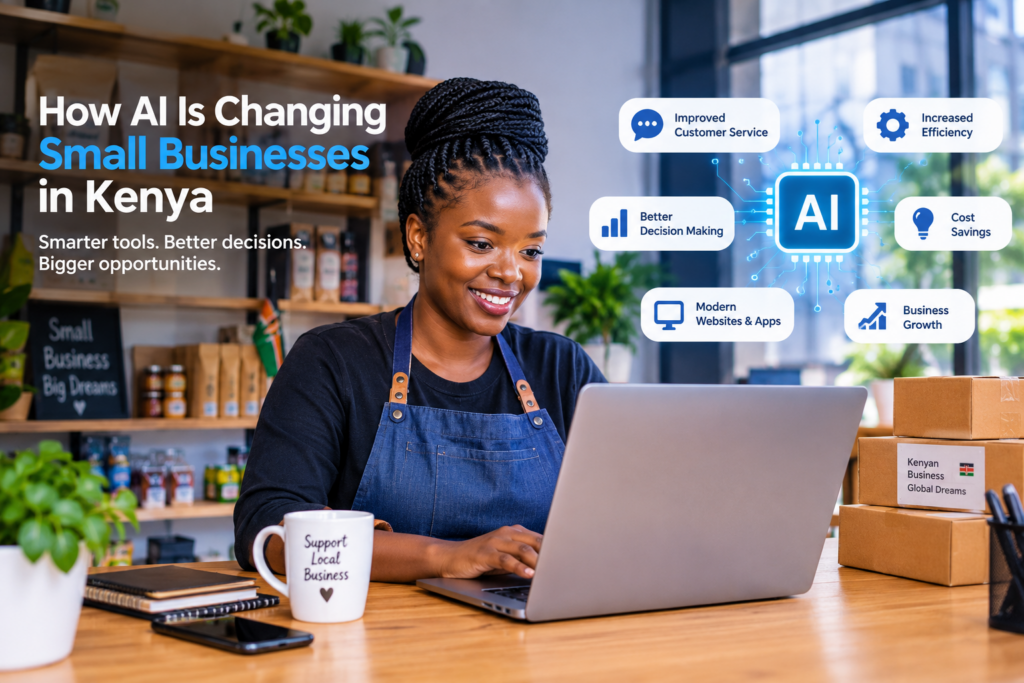
Artificial intelligence is no longer something that belongs only in research laboratories, large technology companies or futuristic movies. AI is becoming a practical business tool, and small businesses in Kenya are increasingly able to use it for everyday tasks such as marketing, customer service, content creation, research, administration and decision-making. You do not necessarily need a large technology department, expensive servers or a team of software engineers to start benefiting from artificial intelligence. A laptop, smartphone, internet connection and the right AI tools can already give a small business access to capabilities that were previously difficult or expensive to obtain.
This shift is happening at an interesting time for Kenya. The country launched its National AI Strategy 2025–2030 in March 2025, with priorities including AI infrastructure, data and AI governance, and AI research, innovation and commercialization. The government has also described AI as an important part of Kenya’s wider digital transformation agenda. At the same time, Kenya’s digital infrastructure continues to expand. The Communications Authority reported 58.5 million data subscriptions by June 2025, while smartphone penetration reached 83.5 percent.
For a Kenyan entrepreneur, therefore, the question is changing. Instead of asking whether artificial intelligence is coming, the more practical question is: Where can AI actually save my business time, reduce repetitive work, improve customer experience and help me make better decisions?
Why Artificial Intelligence Matters to Kenyan Small Businesses
Small businesses often operate under pressure. The owner may be responsible for sales, customer support, marketing, purchasing, accounting, staff management and operations at the same time. A business may have only three employees but somehow have the workload of a company with thirty. This is where AI becomes interesting. Rather than thinking about artificial intelligence as a replacement for the people running a business, it can be viewed as an additional digital assistant that helps people complete certain tasks faster.
Consider a small Nairobi-based company that receives dozens of customer inquiries through WhatsApp, email, social media and its website. Someone has to answer those questions, prepare quotations, follow up leads and create marketing content. AI can help draft responses, summarize conversations, organize information, generate content ideas and assist with repetitive communication. The business owner still makes the important decisions, but less time is spent starting every task from a blank page.
Kenya’s AI Strategy recognizes AI as part of the country’s broader digital transformation and focuses on building infrastructure, skills, governance and commercialization. This matters to small businesses because technology adoption does not happen in isolation. When connectivity, digital payments, cloud services, software platforms and AI tools become more accessible, businesses can build increasingly digital operations without having to develop every technology themselves.
Kenya Is Building an AI-Driven Digital Economy
Kenya already has a strong foundation for digital business. Mobile technology is deeply integrated into everyday commerce, and mobile money has become an important part of the country’s financial ecosystem. The Communications Authority reported 47.7 million mobile-money subscriptions by June 2025, with mobile-money penetration reaching 91 percent at that point. More recent sector statistics reported 51.36 million mobile-money subscriptions and 98 percent penetration by December 2025.
That environment creates an important advantage for AI adoption. Businesses do not have to begin their digital journey from zero. Many already use websites, social media, mobile payments, cloud applications, accounting systems, messaging platforms and online advertising. AI can sit on top of these existing digital workflows and make them more efficient.
The result is not necessarily a dramatic transformation overnight. It may begin with something as simple as using AI to write a product description, summarize a meeting, analyze customer feedback or prepare a first draft of an email. Those small improvements can compound over time.
How AI Is Improving Business Productivity
One of the clearest ways AI is changing small businesses is by helping employees complete routine work more quickly. Imagine a business owner who normally spends an hour creating a weekly report. An AI tool may be able to summarize the underlying information and produce a first draft within minutes. The owner still reviews the report, corrects errors and makes the final decision, but the mechanical part of the work becomes much faster.
The same idea applies to writing. A business may need proposals, quotations, meeting summaries, product descriptions, social media posts, emails, job descriptions and internal documents. AI can help generate initial drafts that employees can then edit. This is especially useful for small companies where hiring a separate writer, researcher or administrative assistant for every task may not be financially practical.
Productivity does not simply mean doing more work. It also means reducing the amount of mental energy consumed by repetitive tasks. When employees spend less time copying information between documents or repeatedly answering the same basic questions, they can dedicate more attention to customers, strategy and creative problem-solving.
This is where small businesses can potentially gain a meaningful advantage. A large company may have specialized departments for tasks that one small-business owner has to handle personally. AI does not automatically eliminate that difference, but it can give a small team access to digital capabilities that make its limited human resources go further.
AI Is Changing Customer Service in Kenya
Customer service is another area where artificial intelligence is becoming increasingly useful. Customers expect businesses to respond quickly, whether they are asking about product prices, opening hours, delivery arrangements, appointments or available services. A business that takes several days to answer a simple question can easily lose a customer to a competitor.
AI can help businesses provide faster first responses. A website assistant, chatbot or AI-powered knowledge base can answer common questions using information supplied by the business. Instead of an employee repeatedly typing the same answer, customers can receive immediate assistance for routine questions while more complicated issues are escalated to a human representative.
This does not mean every customer interaction should become automated. Some conversations require empathy, negotiation, professional judgment or access to sensitive information. A good AI implementation therefore creates a division of work: AI handles predictable questions and basic information, while humans handle situations where human judgment matters.
For Kenyan businesses, this can be particularly useful when customers contact a company outside normal working hours. A small business cannot necessarily afford a customer service employee sitting online twenty-four hours a day. An AI assistant can provide basic information at night, during weekends or when staff members are busy serving other customers.
AI Chatbots and Virtual Assistants
Modern AI assistants are becoming more capable than the traditional rule-based chatbots many businesses used in the past. Instead of responding only to exact phrases, AI systems can understand natural-language questions and provide answers based on business information.
For example, a customer could ask a hotel about available services, a clinic about appointment procedures, a school about admission requirements or an online shop about delivery options. The assistant can be trained or connected to approved business information so that it has useful context.
The quality of the implementation matters enormously. Businesses should not simply connect an AI model to the internet and allow it to invent answers. A useful business assistant needs reliable information, clear instructions, appropriate access controls and a mechanism for escalating uncertain or sensitive questions to humans.
For Wes Empire and businesses building websites, this creates an opportunity to combine website development, AI assistants and business automation into a single digital experience. A website no longer has to be a static collection of pages. It can become an interactive digital assistant for customers.
AI and Digital Marketing for Small Businesses
Marketing is another area where AI can significantly change how small companies work. Creating a consistent marketing campaign requires ideas, writing, graphics, audience research, keyword research, advertising copy, social media planning and performance analysis. For a small business owner managing all of these responsibilities alone, marketing can quickly become overwhelming.
AI can help break the process into manageable pieces. A business owner can use it to brainstorm campaign ideas, generate different versions of advertising copy, analyze a target audience, develop content calendars and transform a long article into social media posts. The business owner remains responsible for the brand’s message, accuracy and final approval.
This is particularly valuable for businesses that previously posted online only when they remembered to do so. AI can make content planning more systematic. Instead of asking, “What should I post today?” every morning, a business can create a monthly content strategy and use AI to assist with producing the supporting material.
There is also an SEO opportunity. AI can help identify related topics, organize content clusters, create article outlines and suggest questions customers might search for online. Used properly, this can help small businesses build a stronger search presence without treating AI as a shortcut around quality.
The important distinction is between using AI to accelerate marketing and simply publishing large quantities of automatically generated content. Search engines and customers still value useful, accurate and original information. AI should support expertise rather than replace it.
How AI Is Helping Kenyan Businesses Create Content
Content creation used to require considerable time. A business might need a copywriter to prepare an article, a designer to create graphics and a social media manager to adapt the content for different platforms. Today, AI can assist with many parts of this workflow.
A business selling furniture, for example, could provide information about a new product and ask an AI system to create a product description, social media caption, email announcement and blog outline. A human can then check the information, add local context, adjust the brand voice and approve the final versions.
The same process works for professional services. An accounting firm can create educational content explaining tax concepts. A software company can publish tutorials. A restaurant can develop recipe-related content. A real-estate company can produce guides for buyers and tenants. The possibilities are broad because almost every business has knowledge that can be transformed into useful content.
AI also makes repurposing easier. One detailed blog post can become a LinkedIn post, Facebook update, short video script, email newsletter and series of social media tips. This is valuable for small teams because it allows one piece of research to support multiple channels.
AI for Social Media and Advertising
Social media is particularly suitable for AI-assisted workflows because businesses constantly need fresh ideas. AI can help generate hooks, captions, campaign concepts and variations of advertising messages. It can also help businesses adapt a message for different audiences and platforms.
However, effective social media still requires something AI cannot simply manufacture: genuine understanding of the customer. A generic post may be grammatically perfect but completely disconnected from the audience. Kenyan businesses should therefore provide AI with real context about their products, customers, locations, pricing, values and brand personality.
The strongest approach is often a partnership between human creativity and machine assistance. AI provides speed and variation; the business provides authenticity and judgment.
AI Is Changing Sales and Lead Generation
Sales teams spend significant amounts of time identifying potential customers, responding to inquiries, following up leads and preparing proposals. AI can assist with each stage.
A website visitor, for example, might interact with an AI assistant and ask about a service. The assistant can answer basic questions and collect information such as the customer’s requirements, budget range or preferred contact method. That information can then be passed to a salesperson for follow-up.
AI can also help prioritize leads. A business may have hundreds of inquiries but limited sales capacity. By analyzing available information, software can help categorize prospects based on predefined criteria. The salesperson can then spend more time on leads that require direct human attention.
Another useful application is proposal generation. Instead of preparing every proposal from scratch, a company can maintain approved templates and allow AI to create an initial version based on a customer’s requirements. A salesperson reviews the document before sending it.
The result is not simply more automation. It is a more organized sales process where fewer leads fall through the cracks.
AI-Powered Business Automation
Business automation is perhaps where AI becomes most interesting. Traditional automation follows predetermined rules: when something happens, perform a specific action. AI adds the ability to interpret information, generate content and work with less structured inputs.
Imagine receiving an email containing a customer request. Traditional automation might move the email into a folder. An AI-powered workflow could identify what the customer wants, summarize the request, classify it and prepare a draft response for an employee to review.
This is particularly useful for small businesses because many administrative processes involve repetitive information handling. AI can help bridge the gap between raw information and an action that a person needs to take.
Automating Repetitive Administrative Tasks
Businesses can explore AI-assisted automation for tasks such as meeting summaries, document classification, email drafting, customer inquiry processing, content planning, report preparation and internal knowledge retrieval.
The key is to start with tasks that are repetitive and relatively low-risk. There is little value in automating a process that only happens twice a year. A task that consumes two hours every day is a much better candidate.
Businesses should also define where human approval is required. Financial transactions, employment decisions, sensitive customer information and legally significant communications should not simply be handed over to an AI system without appropriate controls.
Good automation is not about removing people from the process. It is about removing unnecessary friction from the process.
AI and Business Decision-Making
Artificial intelligence can also help businesses understand their data. Many small businesses collect information but do not necessarily have the time or expertise to analyze it.
Sales records can reveal which products perform best. Customer feedback can identify recurring complaints. Website analytics can show where visitors leave a website. Marketing data can reveal which campaigns generate inquiries. Employee data can help management understand staffing patterns.
AI can help turn these datasets into summaries and questions worth investigating. Instead of manually examining hundreds of rows in a spreadsheet, a business owner could ask an analytics system to identify unusual patterns or explain changes in performance.
There is an important limitation, however. AI-generated analysis is only as reliable as the underlying information and the system’s interpretation of it. Businesses should verify important conclusions rather than treating every AI-generated insight as fact.
The real opportunity is to make data more accessible to decision-makers. A business owner does not necessarily need to become a data scientist to ask useful questions about their own business.
AI in E-Commerce and Online Businesses
Kenya’s growing digital connectivity provides a strong environment for online commerce. By June 2025, the Communications Authority reported 58.5 million data subscriptions, with 78.2 percent on mobile broadband. Mobile-money penetration was also already very high, providing businesses with a familiar digital payment environment.
AI can add another layer to this ecosystem. Online businesses can use AI to improve product descriptions, answer customer questions, categorize products, analyze reviews and assist with marketing campaigns. Customers can potentially receive more relevant recommendations instead of seeing exactly the same products regardless of their interests.
Personalization and Customer Recommendations
Personalization is one of the major applications of AI in e-commerce. If a customer regularly browses particular categories, an online store can potentially use data-driven systems to recommend related products.
For a small online business, sophisticated personalization might initially sound expensive. However, many modern e-commerce platforms and software services already provide AI-assisted features, meaning the business may not need to build the technology from scratch.
The important consideration is transparency and privacy. Businesses should understand what customer data a platform collects, how it is processed and what permissions are required. AI should improve the shopping experience without creating unnecessary privacy risks.
AI and Financial Management
Financial management is another area where automation can reduce administrative workload. Businesses can use software to organize invoices, categorize transactions, monitor expenses and generate financial reports. AI can potentially assist by identifying patterns and highlighting transactions or figures that deserve attention.
A small business owner might not have a full-time financial analyst. That does not mean financial information should remain unexplored. AI-powered accounting and analytics tools can make certain forms of financial analysis more accessible.
However, financial decisions require particular caution. AI should assist with analysis rather than replace qualified professional advice where professional judgment is required. Business owners should also ensure that sensitive financial data is stored and processed through trustworthy platforms.
The most useful financial AI applications are often the least glamorous: finding anomalies, summarizing records, organizing documents and helping people understand information. Those small efficiencies can save considerable administrative time over the course of a year.
AI for Human Resources and Recruitment
Recruitment can be time-consuming for small businesses. A company may receive dozens or hundreds of applications for one position and need to review CVs, communicate with candidates, arrange interviews and maintain records.
AI-powered recruitment software can help organize applications and extract relevant information. It can also assist with drafting job descriptions, preparing interview questions and creating candidate communication templates.
However, employment decisions are sensitive. Businesses should avoid blindly allowing AI to determine who gets hired. AI systems can reproduce biases present in their training data or in the criteria used to evaluate applicants.
AI-Powered Employee Management
AI can also support broader HR operations after recruitment. Businesses can use intelligent software to help employees find policies, understand procedures, request information and access organizational knowledge.
For larger small businesses with dozens or hundreds of employees, an AI assistant connected to an HR management system could potentially answer routine questions about leave procedures, company policies or internal processes.
The principle remains the same: AI should handle information retrieval and repetitive assistance while important employment decisions remain subject to appropriate human oversight.
AI in Website Development and Software
AI is also changing the way software itself is created. Developers can use AI coding assistants to generate code, explain unfamiliar functions, identify potential errors, write documentation and create tests.
This does not mean software developers are becoming unnecessary. Building reliable software requires architecture, security, database design, user experience, testing and business understanding. AI can accelerate parts of the development process, but someone still needs to understand what the application is supposed to accomplish and whether the resulting software is safe and reliable.
For businesses, this could eventually make custom software development more accessible. A company might previously have avoided building an internal system because development costs were too high. AI-assisted development can reduce some development time, although the total cost still depends on requirements, security, integrations, maintenance and complexity.
This is especially relevant for Kenyan businesses that need systems tailored to local workflows, such as M-Pesa integrations, employee management, school management, healthcare systems, property platforms and customer portals.
AI and Cybersecurity for Small Businesses
AI creates opportunities, but it also introduces new cybersecurity considerations. Cybercriminals can use AI to create more convincing phishing messages, automate attacks and manipulate information. Small businesses are often attractive targets because they may have valuable data but fewer security resources than large enterprises.
Kenya’s Communications Authority reported significant cyber-threat activity in its sector statistics, illustrating why cybersecurity cannot be treated as an optional technology upgrade. Businesses should combine AI adoption with basic security practices such as strong passwords, multi-factor authentication, regular updates, backups, access controls and employee awareness.
AI can also assist defenders by analyzing large volumes of security information and identifying suspicious patterns. But again, the technology needs to be deployed responsibly.
Protecting Business Data in an AI-Driven World
Before employees start uploading company documents into an AI service, management should understand the platform’s privacy and data-handling policies. Sensitive customer information, passwords, confidential contracts, financial records and personally identifiable information should not be casually pasted into public AI tools.
Businesses should establish simple AI-use policies. Employees need to know what information they can share with AI systems, which approved tools they can use and when human review is mandatory.
The future of business AI will therefore involve two parallel conversations: how to get more value from AI and how to use it safely.
Challenges Preventing Some Kenyan Businesses From Adopting AI
AI adoption is not automatically easy. Cost, skills, connectivity, data quality, security concerns and uncertainty can all become barriers. Some business owners may also struggle to identify a practical use case. Buying an AI subscription simply because everyone is talking about AI does not create business value.
Skills are another important issue. AI tools are becoming easier to use, but effective implementation still requires people who understand the business problem being solved. Kenya’s AI Strategy includes skills development among the broader national AI agenda, reflecting the importance of human capacity alongside technology.
There is also the issue of trust. Business owners need to understand what AI can and cannot do. An AI model can generate a confident-sounding answer that is incorrect. It can misunderstand a customer request. It can produce biased recommendations. It can also expose information if used carelessly.
The answer is not to avoid AI. It is to introduce it deliberately. Start with measurable problems, test small workflows, review results and expand only when the technology demonstrates value.
How Much Does AI Cost for a Small Business?
The cost of adopting AI varies enormously. A small business can begin with free or low-cost AI tools for writing, brainstorming, research and productivity. More advanced implementations involving custom chatbots, business integrations, private knowledge bases, automation workflows or software development can require a larger investment.
This is why asking “How much does AI cost?” is often less useful than asking “What business problem am I trying to solve?”
If the problem is producing social media content, a relatively inexpensive AI subscription may be enough. If the problem is automating customer service across a website, WhatsApp and an internal CRM, the business may need a custom implementation.
Businesses should therefore calculate potential value. If an automated workflow saves ten employee-hours every week, reduces missed leads and improves response times, it may justify an investment that would not make sense for a company with a different workload.
AI should be treated like any other business technology investment: identify the problem, estimate the benefit, consider the risks and measure the result.
Practical AI Tools Kenyan Businesses Can Start Using
There is no single AI platform that every business needs. The right tools depend on the company’s work. General-purpose assistants can help with research, writing, brainstorming and analysis, while specialized platforms can handle customer service, marketing, accounting, design, software development and automation.
A practical starting toolkit might include an AI assistant for research and writing, an AI-enabled design platform for marketing materials, an automation platform for connecting business applications, analytics tools for understanding customer behavior and an AI-enabled customer support system where appropriate.
Starting Small Instead of Trying to Automate Everything
The biggest mistake a business can make is trying to transform every process at once. Start with one repetitive problem.
Perhaps employees spend hours answering the same customer questions. Build an AI knowledge base.
Perhaps marketing takes too much time. Build an AI-assisted content workflow.
Perhaps staff spend hours preparing reports. Automate report summaries.
Perhaps leads are being lost because nobody follows up quickly. Build a structured lead-management workflow.
Once one process works, measure the outcome. Did response time improve? Did employees save hours? Did customers receive faster answers? Did the business generate more qualified leads?
If the answer is yes, expand from there.
The Future of AI for Small Businesses in Kenya
The next stage of AI adoption is likely to move beyond simple chatbots and content generation toward AI agents and connected business systems. Instead of asking an AI tool to perform one isolated task, businesses will increasingly connect AI to their websites, CRM systems, accounting platforms, HR systems, databases and communication channels.
Kenya’s national AI agenda is already focused on building the infrastructure, governance, research and commercialization environment needed to support broader AI development. The government published an implementation roadmap for the 2025–2030 strategy in late 2025, reinforcing the longer-term nature of this agenda.
For small businesses, this could eventually mean software that behaves more like a digital operations assistant. An AI system might monitor incoming inquiries, summarize sales activity, prepare reports, identify overdue tasks and notify employees when human intervention is required.
That future is not about handing the entire company to a machine. It is about creating systems where people spend less time moving information around and more time making decisions, serving customers and growing the business.
How to Start an AI Strategy for Your Business
The easiest way to start is with a simple audit of your daily operations. Write down the tasks that employees repeat every day or every week. Look for activities involving writing, summarizing, searching, categorizing, responding, reporting or transferring information between systems.
Next, identify one task with a clear measurable outcome. Perhaps it currently takes three hours and you want to reduce it to one hour. Perhaps customers wait several hours for responses and you want to provide immediate answers to common questions.
Then select an appropriate AI tool and test it with a limited amount of work. Keep humans involved during the testing phase. Review the accuracy of the output and make sure sensitive information is protected.
Finally, measure the result. AI adoption should not be based purely on excitement. Ask whether the technology actually saves time, improves customer experience, increases revenue, reduces errors or provides better information for decision-making.
For businesses that need something more advanced than off-the-shelf tools, custom software development can connect AI with existing business systems. This is where web development, APIs, databases, automation and AI can come together to create solutions designed around a company’s specific workflow.
Conclusion: AI Is Becoming a Business Tool, Not Just a Technology Trend
Artificial intelligence is changing the way small businesses can work, and Kenya is developing within a broader national push toward digital transformation and AI adoption. From customer service and content creation to software development, recruitment, analytics and automation, AI is giving smaller teams access to capabilities that were previously difficult to achieve without significant resources.
The opportunity is not necessarily to replace employees or automate everything. The more practical goal is to remove repetitive work, improve access to information and help people make better use of their time.
Kenya already has important foundations for this transformation, including widespread mobile connectivity and digital financial services. The country’s AI Strategy 2025–2030 adds a national framework around infrastructure, governance, skills, research and commercialization.
For a small business owner, the best time to explore AI is not when every competitor has already implemented it. Start by identifying one frustrating, repetitive or expensive process. Find out whether AI can improve it. Test the solution, measure the results and build from there.
The businesses that benefit from AI will not necessarily be the ones using the most sophisticated technology. They may simply be the ones that learn how to combine human judgment, local knowledge and useful technology to solve real business problems.
Frequently Asked Questions
1. How can a small business in Kenya use AI?
A small business can use AI for customer service, marketing, content creation, research, sales follow-ups, document preparation, data analysis, recruitment assistance and administrative automation. The best starting point is usually a repetitive task that consumes significant employee time.
2. Is AI expensive for Kenyan small businesses?
Not necessarily. Many AI tools offer free or relatively affordable entry-level plans. More advanced solutions, such as custom AI assistants, business automation and AI-integrated software, require greater investment depending on the complexity of the project.
3. Can AI replace employees in small businesses?
AI can automate certain tasks, but businesses still need people for judgment, customer relationships, strategy, creativity, accountability and many operational responsibilities. In many cases, the more useful approach is to use AI to help employees work more efficiently rather than treating AI simply as a replacement for staff.
4. Is AI safe for businesses to use?
AI can be used safely when businesses apply appropriate security and privacy controls. Companies should be careful about entering confidential information into public AI tools, should use strong authentication and access controls, and should establish clear policies governing employee use of AI.
5. Where should a Kenyan business start with AI?
Start with one specific business problem. Identify a repetitive task, test an appropriate AI tool, keep a human involved in reviewing the results and measure whether the solution saves time, improves customer service, reduces errors or contributes to business growth. Once the first use case works, the business can expand its AI strategy.